This entails the need for precise and consistent train operations and an in-depth understanding of sophisticated systems. Although the rail system is expanding and advancements in technology are underway, the conventional training process is inadequate for drivers, operators, and technical personnel to overcome the tasks in real life. This is where the VR train simulator emerged as an effective and viable solution, bridging the theoretical and practical knowledge gaps.
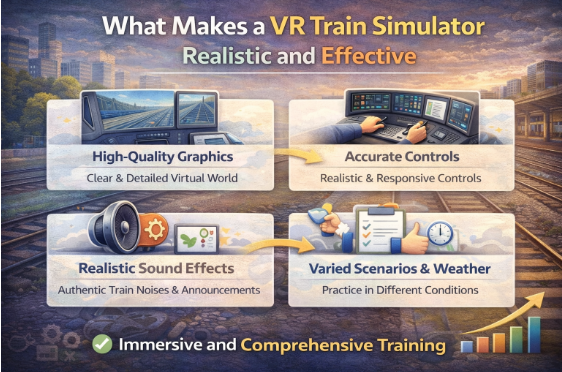
Not all simulators are alike, however. If VR training is to offer benefits in a realistic and practical way, it must first be realistic and then effective. Each of these requires a combination of accuracy in technology and immersive training skills. Listed below is what must constitute a highly effective VR training system used in the rail industry.
Submilling Analysis of the Hull Forging Process
Realism has to begin in the cab. In other words, the simulator has to model the actual operating environment for the driver as realistically as possible, so that the skills learned can be transferred easily to the actual system operation.
Here’s how it helps:
- Providing a proper cab layout and seating position
- Correct placement of controls and displays
- Realistic visibility through windshields and mirrors
Authentic Control Response and Feedback
Because muscle memory and familiarity with the procedure will be accomplished through exposure to the virtual cab that duplicates the existing cab, any hesitation or mistakes made in the train will be eliminated.
Realistic Behaviour and Movement of Trains
Realistic visuals alone are not sufficient. The trainee needs to function as a real one.
A good quality VR train simulator will simulate the following:
- Accelerating and braking performances
- Weight, momentum, and stopping distance
- Gradient, Curvature, and Load Variation
- Effects of weather and track conditions
With realistic dynamics, drivers learn true speed estimation, stopping positions, and the accuracy of stopping, all of which play a pivotal role in ensuring passenger safety and functionality.
Immersive Environments and Infrastructure for Rail
Situational Awareness is one of the skills required in the operation of railways. This includes the interpretation by the drivers of the signals, the condition of the tracks, the stations, as well as the other infrastructure surrounding the train.
Realist simulator will simulate:
- Track geometry, switches, and gradients
- Signaling systems, Line-side equipment
- Stations, platforms, and tunnels
It is here that the simulated conditions exist in which the trainees get a reality check without actually training in a real-life rail system.
Scenario-Based and Emergency Training Capability
These are some of the most critical skills that trainees should possess in train operating, and they may arise in situations that occur very rarely – but are likely to require an instantaneous correct response. In some cases, it may not be possible or even safe to train them in real-life situations.
A good VR simulator offers trainees the following chance to practice:
- Braking conditions
- Failures of the signal or of the system
- Obstruction on track
- Reduced visibility or weather extremes
By practicing such scenarios in the virtual reality environment, drivers develop calm and confident reactions that are the distinction between a manageable incident and a major accident.
Control and Training Flexibility
A simulator’s quality depends on the training environment that integrates the simulator. The finest simulators put the entire training process, including the trainer, completely under the instructor’s control for any single session.
This encompasses skills such as:
- Change difficulty levels
- Live trigger failures or incidents
- Pause, rewind, or replay situations
- Align training to the target audience’s experience
This also provides the flexibility to cater to the simulator requirements for initial training, certification, refresher courses, and development of expert skills in one common platform.
Performance Updates and Objective Feedback
One of the big strengths of the use of VR for training the driver is that the data collected can be vast, much more comprehensive than if the training had been undertaken on track.
Active systems monitor:
- Reaction times
- Speed and Braking Accuracy
- Signal compliance
- Error patterns and improvement with time
This will also allow the instructors and organization to objectively assess their competencies, thereby being able to address deficits and provide training sessions tailored specifically to them.
Comfort, Robustness, and the User Experience
During training, it should be ensured that the users are concentrated as well as comfortable. If they are not, it could affect training negatively.
A real VR system will always ensure that:
- Fixed frame rates, low latency
- Accessible interaction design
- Reliable hardware integration
It is going to ensure that they feel as though they are experiencing everything as natural and without any breaks, so they can devote their attention to learning functions and not get bogged down by technology-related distractions.
Importance of High-Quality Digital Models
The level to which Virtual Reality training is realistic is, therefore, highly contingent on the digital assets used in Virtual Reality training. If Virtual Reality training is to function within a realistic framework, there is a requirement for accuracy in regard to models used in training, details within the cab interior, and the environment itself.
It’s here that professional 3D modeling enters the critical arena. An effective 3D model ensures that the virtual representation accurately reflects scale, structural designs, and functionality on all virtual Reality platforms. Such professional-level models will enable increased immersion, the ability to factor in accurate physics, and the ability to update the simulators when the actual train-related infrastructure changes.
Scalability and Future Viability
A good training system using virtual reality is an ongoing solution rather than a short-term fix with long-term implications. The most effective simulator is scalable from fleets to depots to areas while being able to conform to each different environment.
This will allow rail organizations to:
- Standardize training
- Strengthen support system
- Updated information for newly introduced routes or trains
Scalability will provide assured value even in situations where demands change in relation to operating requirements.
Conclusion
Realistic and efficient train simulation training cannot be achieved by mere visualization; rather, it calls for immersion, detail, and thorough instruction. The train simulator VR achieves all this by combining accurate train cab simulation, realistic train models, immersive rail systems, and train simulation tools into a single entity.
Aided by high-quality digital content created through the provision of high-quality 3D modeling services, simulation in the VR environment is the key facilitator of safe operations, swift skill-building, and standard training outcomes. This means that, given the rising complexity of the rail industry and the security standards required of it, simulation training through VR is not an afterthought but an essential component of trainers and trainee accommodation.